


On Friday, October 21, 2022, the weather in Auckland, New Zealand (NZ) was cloudy and the temperature was 16 degrees C. Since this winter (June-August) was the peak of the COVID-19 pandemic in NZ, Ania and her family have not traveled for a while, so Ania was planning a weekend family trip, watching the weather report: sunny and fine weather with a temperature of 20 degrees.
 |
| Fig 1: ESR COVID-19 Wastewater Surveillance Dashboard |
Friday, October 21, 2022, the weather in Auckland, New Zealand (NZ) was cloudy and the temperature was 16 degrees C. Since this winter (June-August) was the peak of the COVID-19 pandemic in NZ, Ania and her family have not traveled for a while, so Ania was planning a weekend family trip, watching the weather report: sunny and fine weather with a temperature of 20 degrees.
Ania used to like to visit Lake Taupo the most, but at this moment she had to change her plan, even the pandemic in Auckland has generally slowed down. This time, Ania consulted the Environmental Research and Science (ESR)'s COVID-19 Wastewater Surveillance Dashboard, and she changed plans for her family.
Ania, who lives in Auckland (yellow circle area in Figure 1), learned from the website that the recent pandemic has slowed down (upper right in Figure 1), but many areas are still unstable (red triangle area in Figure 1). When checking the situation in Lake Taupo, the map showed a red triangle. Ania took a closer look at the trend chart and found that although the number of confirmed cases decreased, the wastewater data showed an increase. Therefore, she changed the location and decided to go to Kawakawa Bay, where the overall pandemic situation has declined. (Figure 1 map, blue triangle area).
 |
| Fig 2: Wastewater Variant Analysis |
Not only that, but Ania had older and younger members in her family, so she further checked the situation of SARS-CoV-2 variants across the country and east of Auckland (Figure 2).
Since NZ was in a state of competition for multiple variants of the COVID-19 , the scientific uncertainty at the time was high. Therefore, it was changed to an outdoor picnic to avoid indoor dining and group gatherings, in order to reducing the unknown risks of family travel.
However, these data about COVID-19 are different from the confirmed clinical data familiar to the public (i.e. confirmed cases, hospitalization, moderate to severe disease, death, etc. in the blue curve in Figure 1), and what is this kind of "additional" environmental data?
The green curve in Figure 1 covers 73% of the NZ population, and the average number of SARS-CoV-2 genomes detected in wastewater per person per day. This is from the surveillance results of wastewater samples from lavatory, sinks and drains in households in the community. Most of these shit & poops samples are regularly collected by an automatic sampler within 24 to 25 hours for testing. After estimating the number of viruses and analyzing the variants, a weekly wastewater surveillance report is provided, and finally published on the dashboard to inform the public of potential local COVID-19 risks. Wellington Laboratory's NZ National Wastewater Surveillance for COVID-19 footprint work is like the work of a Lavatory Detective Agency.
Taking a closer look at the work of the "Lavatory Detective Agency" in NZ, it can be roughly divided into three stages (Figure 3):
 |
| Fig 3: Chronicles of New Zealand Lavatory Detective Agency for SARS-CoV-2 Footprints |
The first stage of establishment & testing:
In 2020, when the pandemic broke out in the early stage, the COVID-19 wastewater surveillance project began to be established in April.
After the alert level was raised to level 4 in May, ESR and the National Health Coordination Center (NHCC) coordinated the prevention strategy and established a national clinical data repository (Clinical Data Repository, CDR) for all COVID-19 test reports in laboratories across the country.
From July to November, closed sampling research was carried out. On the one hand, it provided a "time snapshot" of wastewater viruses, and on the other hand, it provided the theoretical basis for NZ's wastewater surveillance task.
The second phase of verification & expansion:
During the "Zero COVID" in 2021, in areas with zero confirmed cases, the evidence of the SARS-CoV-2 footprints has been detected in wastewater. In Stratford, a small town in the Taranaki (where wastewater services cover 97%) since July 2021, it has joined the COVID-19 wastewater surveillance task. For the first time, virus fragments shed after infection with SARS-CoV-2 (or SARS-CoV-2 RNA fragments) were detected in the wastewater samples.
After the wastewater "disease detective" solved the case based on the above-mentioned closed sampling research, the Detective Agency continued to strengthen public health measures, such as community testing and vaccination, canceling some community activities, and increasing wastewater sampling and testing.
Subsequently, it was found in Stratford that 6 confirmed cases were all from the same family, and the pandemic was quickly brought under control. It was not until 3 months later that further community cases were found in the wastewater, so the results of the COVID-19 wastewater surveillance tasks were verified and has been reported in the World Health Organization as a case report.
The third stage of daily wastewater surveillance:
After NZ gave up Zero COVID, it provided new digital tools for the public to "living with the COVID", allowing the exploration of the COVID-19 wastewater surveillance report to be like checking the weather report, helping the public to manage their own safety.
“NZ’s move to self-reporting has made our official case numbers less reliable than ever before – and that’s where wastewater testing comes in”, microbiologist Siouxsie Wiles and ESR geneticist Mike Bunce, the ESR scientists explained.
July 2022, NZ launched an interactive COVID-19 wastewater dashboard, using new tools to track the COVID-19 footprints, assisting the public to be ware of national and regional pandemic trends, and providing temporal and spatial visual assistance, such as map area options and searches. It also supports the comparison of trends in different time periods as shown in Figure 1 and Figure 2.
So how does NZ's "Lavatory Detective Agency" establish the relationship between wastewater data and clinical data?
It was hard to detect SARS-CoV-2 cases during the time of Zero COVID in NZ. How could NZ solve the problem of wastewater sensitivity when the virus in wastewater was extremely low? Figure 4 illustrates the overall research landscape.
 |
| Fig 4: Relations between COVID19 clinical and wastewater data |
In July 2020, ESR selected a community with a population of about 120,000 to sample wastewater daily in two areas. They are the Managed Isolation and Quarantine Facility (MIQF) and the wastewater treatment plant (WWTP).
The left side of Figure 4 is the clinical analysis of COVID-19 that is familiar to the general public, and the right side is to illustrate the analysis process of COVID-19 wastewater-based epidemiology (WBE).
The main difference between the two methods lies
in the source of samples and sampling methods.
The follow-up quality control is based on the purpose of the researcher, and different viruses are used as the control group. For example, this study chose to use Feline Infectious Peritonitis Virus (FIPV) and Murine Norovirus Virus (MNV) as external process controls to monitor viral copies and evaluate inhibition by quantitative RT-qPCR.
Subsequent processes such as virus concentration, RNA extraction, use of PCR to test whether the sample is positive or negative, or further sequencing are the same as the process of people testing the virus from nasal swabs.
Finally, using the clinical data in the EpiSurv surveillance database of the Ministry of Health, four infectious models (Total Cases, Infectious Cases: reported symptomatic cases or imputed asymptomatic cases, Relative Infectious Cases, New Daily Cases), compared with the wastewater data for statistical analysis to confirm the relationship between clinical cases and wastewater data, and verified that in a low-infection environment, wastewater data can still help to detect about 10 positive cases in an area of 100,000 people.
 |
| Fig 5: COVIDPoops19 snapshot (20230507) |
"Lavatory Detective Agency"
detects SARS-CoV-2 footprints in the environment. In the near future,
regardless of whether the next super variant is discovered, this kind of work
to track the source of potential variants will help researchers understand the
biological factors that lead to the mutation, or help ordinary people like Ania
and her family: checking the COVID-19 wastewater data is like checking the
weather data, thus self-risk prevention has become a simple daily routine. And
if scientists or digital engineers want to further use the source data of the NZ
"Lavatory Detective Agency", the "Open Lavatory" provided
by ESR is available in the open database.
Reference:
[1] https://www.health.govt.nz/covid-19-novel-coronavirus/covid-19-health-advice-public/covid-19-wastewater-testing
[2] ESR News: https://www.esr.cri.nz/home/about-esr/media-releases/streamlining-covid-19-laboratory-data-to-ministry-of-health/ ; https://www.scoop.co.nz/stories/SC2005/S00024/sysmex-and-esr-collaborate-on-national-covid-19-results-cdr.htm. 2020/5/12
[3] Hewitt, Joanne, et al. "Sensitivity of wastewater-based epidemiology for detection of SARS-CoV-2 RNA in a low prevalence setting." Water Research 211 (2022): 118032.
[4] Harvey, Helen, "The riddle in the wastewater: Taranaki 'disease detectives' solved a Covid-19 mystery", https://www.stuff.co.nz/national/health/128983961/the-riddle-in-the-wastewater-taranaki-disease-detectives-solved-a-covid19-mystery. 2022/6/18
[5] Siouxsie Wiles and Mike Bunce, "As Covid case counts become less accurate, wastewater testing is riding to the rescue", https://thespinoff.co.nz/science/13-06-2022/as-covid-case-counts-rapidly-lose-accuracy-wastewater-testing-is-riding-to-the-rescue
[6] "ESR launches interactive COVID-19 wastewater dashboard to better track the virus's progress", https://thespinoff.co.nz/science/13-06-2022/as-covid-case-counts-rapidly-lose-accuracy-wastewater-testing-is-riding-to-the-rescue
[7] COVIDPoops19: Summary of Global SARS-CoV-2 Wastewater Monitoring Efforts by UC Merced Researchers Details: https://ucmerced.maps.arcgis.com/apps/dashboards/c778145ea5bb4daeb58d31afee389082
[8] Callaway, Ewen. "These scientists traced a new coronavirus lineage to one office-through sewage." Nature News. https://www.nature.com/articles/d41586-022-02996-y. 2022/9/26
[9] ESR Open Data: https://github.com/ESR-NZ/covid_in_wastewater
English Title: Use "wastewater" to monitor viruses and bacteria! Wastewater Epidemiology
科學月刊 . No. 640. pp.64-67, 2023-04-01
URL: https://www.scimonth.com.tw/archives/6366
 |
| 圖一: 廢水科學術語的歷史 |
廢水科學術語的歷史
檢測廢水起源可追溯到1854年倫敦蘇荷區的寬街霍亂爆發事件。當時在一座有多人霍亂死亡的房屋附近公井和污水池,發現糞便洩漏細菌並汙染到泵的供水系統而引發流行病。1950年代中期「廢水追蹤或跟蹤(Wastewater Tracing or Tracking)」自南非大壩蝸牛血吸蟲感染的廢水相關研究後陸續出現,至1970前後「廢水偵測(wastewater monitoring)」與「廢水監測(wastewater surveillance, WWS) 」或「基於廢水的監測(Wastewater-Based Surveillance, WBS) 」常見於工業廢水檢測研究中。到了2000年代研究追蹤海洛因和其他非法藥物等議題出現了「污水流行病學(sewage epidemiology)」和「基於廢水的流行病學(wastewater-basedepidemiology, WBE)」(中文經常簡稱廢水流行病學)學科用語的混用,主要描述以廢水中穩定人類排泄的物質,可用於計算初始濃度為前提的科學領域。
但至2014年「廢水流行病學」漸漸取代「污水流行病學」一詞,雖然汙水和廢水二詞仍常見互用,但世界衛生組織(WHO)近期官方文件主要使用「廢水監測」一詞,學者亦建議標準化相關科學技術,支持使用「廢水監測(WWS)」和「廢水流行病學(WBE)」作為共通用詞。若檢視定義的差別,我們可自公共衛生視角區分(圖一附表): 廢水追蹤或跟蹤,主要是為識別病原體或毒物來源; 廢水偵測是為確保廢水排放不會造成公共衛生風險的行動; 廢水監測則強調系統地、持續測試廢水以造福公眾健康可能與公共衛生政策相關; 廢水流行病學(WBE)即是將廢水中發現的病原體和化學物質與人口健康聯繫起來的科學領域[3][4][5][6]。
COVID-19前廢水研究了哪些傳染性人類病原體?
歷來廢水監測(WWS)用於評估引起腹瀉相關疾病的水傳播和糞口傳播病原體,研究較為成熟的人類傳染病病原體包括微小核糖核酸病毒科、杯狀病毒科和呼腸孤病毒科等(圖二以*表示)。國際關注流行病如冠狀病毒、伊波拉病毒、茲卡熱以及已提供公共衛生行動或政策資訊的小兒麻痺/脊髓灰白質炎病毒(圖二以***表示)為代表,但文獻中罕見流感和愛滋病毒在WWS中出現[7]。
 |
| 圖二: 新冠大流行前已知的傳染病廢水監測(WWS) : 病毒以科/屬分類 |
若專以冠狀病毒為對象,早期的冠狀病毒廢水檢測鑒於具有高流行潛力的新病毒出現,通常涉及動物、人類和環境的複雜動態影響,因此環境監測自1970年代起,透過監測地表水、廢水、泥漿和生物固體中的冠狀病毒來了解這類病毒在水迴圈中的狀態,其種類包括人類冠狀病毒(HCoV)、人類冠狀病毒229E (CoV-229E)、HKU1和嚴重急性呼吸道症候群冠狀病毒(SARS-CoV);人畜共患的β冠狀病毒如中東呼吸症候群冠狀病毒(MERS-CoV)以及動物冠狀病毒:如牛冠狀病毒(BCoV)、小鼠肝炎病毒 (MHV)等,此階段著重冠狀病毒在廢水中的生存狀態與病毒回收效率等,但整體知識仍非常稀缺和零碎[8]。
COVID-19大流行後
 |
| 圖三: 新冠大流行後廢水監測(WWS)概況 |
與此同時,廢水基因組監測技術的新進展,解決了廢水中多種病毒株問題,如圖三中根據WHO分類新冠病毒變種病毒株,能在廢水樣本中提前 14 天發現新變種,並確定臨床監測未能捕獲的病毒傳播實例,這對高風險人群如學生宿舍,機場、醫院、養老院等長期護理設施,除提供早期揭示預警外,亦能輔助遏制和緩解病毒的爆發,長期而言WWS更是追蹤病毒譜系動態綜合優勢的重要工具[10]。
進一步就廢水流行病學(WBE)角度分析,在資源豐富的國家主要在下水道和污水系統進行評估,但在資源匱乏的環境中,大部分居民沒有連接到廢水集中處理廠,使用坑式廁所、化糞池或露天排便,因此根據廢水系統的差異,WWS過程亦有所不同。總體而言如圖四所示,包括採樣、採樣方法、病毒濃度濃縮技術、控制過程使用對照病毒、病毒分離、RNA提取、病毒檢測和定量測序,最後完成流行病學建模分析流行趨勢。不過WBE目前仍面臨許多挑戰,包括在採樣控制方面中: 水流日常變化、廢水系統差異、天氣因素、溫度、沉澱率、以及病毒脫落等因素。在病毒復原和濃縮方面: 濃縮方法效率、核糖核酸(RNA)萃取和純化效率、以及RNA的儲存等。病毒檢測和/或定量方面: RNA品質、RNA數量、PCR抑製劑、以及資料正歸化等這些挑戰均會影響新冠廢水監測面臨回收率低和處理時間長等缺點[11]。
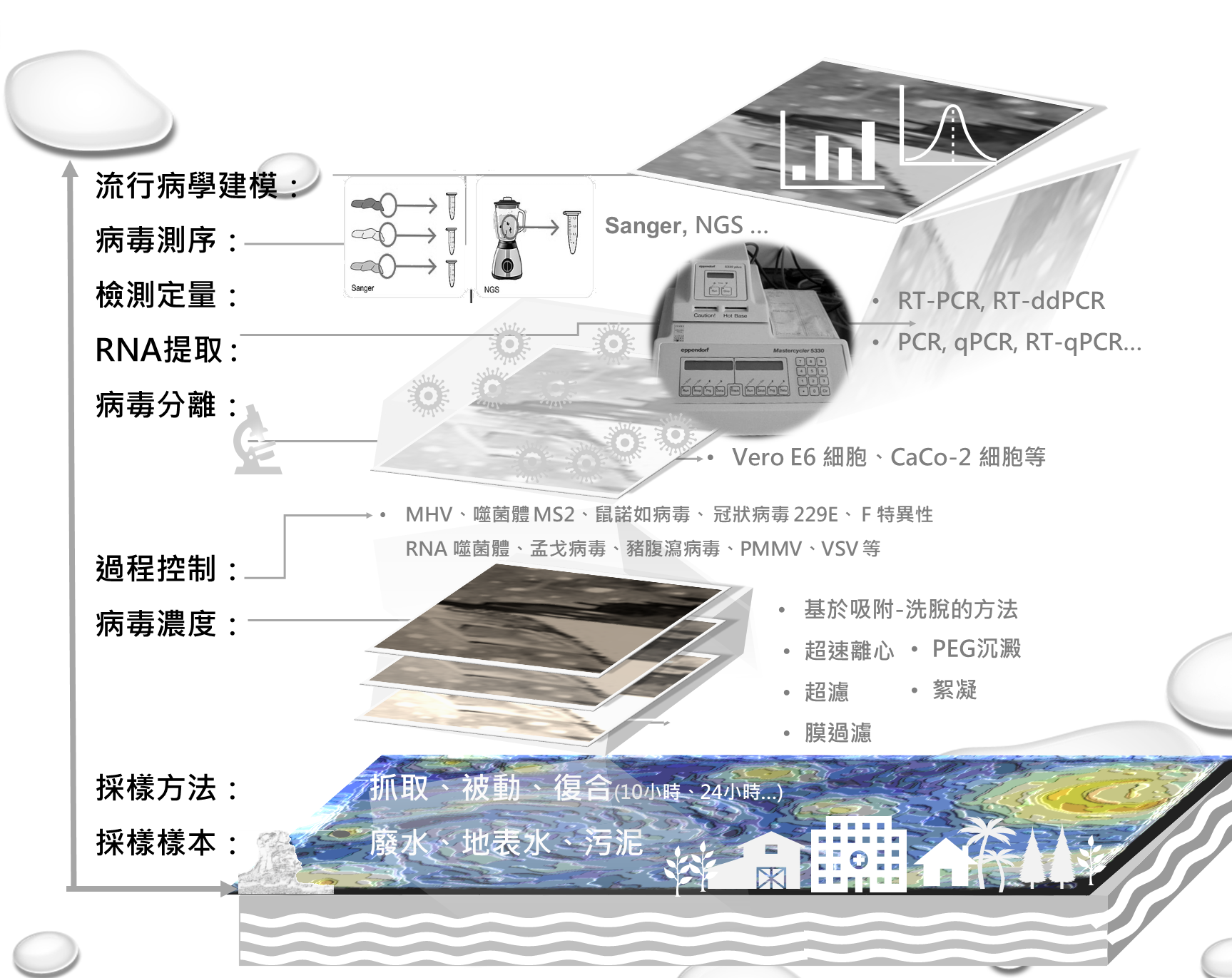 |
| 圖四: 新冠廢水流行病學(WBE)分析過程 |
WWS是用於補充而不是取代基於個人診斷測試的環境監測
與臨床診斷測試相比,SARS-CoV-2廢水監測的不同處在於社區規模採樣計劃的設計和解釋,以及從廢水和環境水樣中濃縮和提取RNA所嘗試不同的檢測方法。由於病毒RNA可在症狀出現和診斷測試前排放到廢水中,在新冠高流行情況下,SARS-CoV-2廢水監測有助於記錄趨勢,而在低流行情況或缺乏臨床測試證據情況下,則可提供早期預警,同時廢水病毒載量可用於監測公共衛生社會措施的影響,包括增加或放寬限制,以及加強風險溝通,警告社區有關病毒(重新)出現,並建議社區有關檢測、檢疫、隔離、疫苗接種和尋求醫療保健等行為。綜合來說,其優點包括提供客觀指標,不易受到診斷測試中固有偏見影響,如尋求健康的行為、疾病嚴重程度(包括有症狀無症狀)、醫療保健和測試可及性、醫生和個人對測試的傾向以及成本和報告的限制等[12]。
我們以紐西蘭環境研究與科學研究所的互動式新冠廢水監測網作為實例(圖五),該儀錶板於2022年7月上線提供民眾追蹤SARS-CoV-2足跡,查看全國、區域疫情等最新趨勢。一方面提供時空視覺化地圖,另一方面呈現廢水統計資料提供區域選項及搜尋、比較不同時段趨勢等功能。自圖五(a)我們可觀察到威靈頓在三個時段(綠色虛線圈)顯示廢水資料與確診病例相應尖峰的不同: 疫情高峰時期由於臨床檢測充足,確診病例與廢水資料約呈一致,而低流行時期或因人們對搓鼻子感到疲憊(或認為不需要)、整體檢測能量趨緩,亦或是通報意願下降等因素出現廢水資料高峰遠超過確診狀況。民眾亦可檢視最新的SARS-CoV-2變種病毒,在圖五(b)(c)分別呈現比例與升降趨勢資訊,綜合來說,廢水資料不僅補充了臨床監測,也提供民眾防疫環境背景資訊基礎。儀錶板顯示廢水資料涵蓋全紐西蘭73%的人群,不到一克的小樣本只需少數昂貴PCR,相對百萬人每人臨床PCR的大量檢驗與成本,是的,SARS-CoV-2在廢水中水聽八方的嘀咕聲實在非常廣,滴滴咕咕,可識別可預警可追蹤還可輔助民眾防疫自主時,做好自我風險再評估。
 |
| 圖五: 紐西蘭環境研究與科學研究所(Institute of Environmental Science and Research, ESR)新冠廢水監測網儀錶板 COVID-19 Wastewater Surveillance Dashboard: https://esr-cri.shinyapps.io/wastewater |
[1] Nelson, Bryn. What poo tells us: wastewater surveillance comes of age amid covid, monkeypox, and polio. BMJ 378 (2022).
[2] COVIDPoops19: https://ucmerced.maps.arcgis.com/apps/dashboards/c778145ea5bb4daeb58d31afee389082
[3] Kilaru P, Hill D, Anderson K, Collins MB, Green H, Kmush BL, Larsen DA. Wastewater Surveillance for Infectious Disease: A Systematic Review. Am J Epidemiol. (2022) Oct 13.
[4] Larsen, David A., et al. Wastewater monitoring, surveillance and epidemiology: a review of terminology for a common understanding. FEMS microbes 2 (2022). 2021-08-19
[5] Gonçalves, José, et al. Centralized and decentralized wastewater-based epidemiology to infer COVID-19 transmission–A brief review. One Health (2022): 100405.
[6] World Health Organization. Environmental surveillance for SARS-COV-2 to complement public health surveillance: interim guidance, 14 April 2022. No. WHO/HEP/ECH/WSH/2022.1. WHO (2022).
[7] [3]
[8] Carducci, Annalaura, et al. Making
waves: coronavirus detection, presence and persistence in the water
environment: state of the art and knowledge needs for public health. Water Research 179 (2020): 115907.
[9] McPhillips, D and Howard,J (CNN), The RSV surge didnt come out of nowhere, but gaps in data made it tougher to predict, October 27, 2022. https://edition.cnn.com/2022/10/27/health/virus-surveillance-data-gaps/index.html
[10] Karthikeyan, Smruthi, et al. Wastewater sequencing reveals early cryptic SARS-CoV-2 variant transmission. Nature 609.7925 (2022): 101-108.
[11] Aguiar-Oliveira, Maria de Lourdes, et al. Wastewater-based
epidemiology (WBE) and viral detection in polluted surface water: A
valuable tool for COVID-19 surveillance—A brief review. International journal of environmental research and public health 17.24 (2020): 9251.
[12] [6]
-------------------------------------------
註: 本文之圖均作者自製,許多影像改製來源為Wikimedia Commons (https://commons.wikimedia.org/)中公眾領域(Public domain)授權圖片。唯圖五是網站截圖再製:https://esr-cri.shinyapps.io/wastewater
medium URI: https://medium.com/@andreahuang2019/廢水中病毒細菌的嘀咕-初稿-7603328d1896
Campbell, Kristina. "Preparing health-care systems for future pandemics." Nature 610.7933 (2022): S38-S40 (26 October 2022)
Highlight | 重點 :
--------------------------------------------------------------------------------------------------------------------------------------------

Facet of this article | 此文探討的議題: https://www.entitree.com/en/facet_of/Q114968383

--------------------------------------------------------------------------------------------------------------------------------------------
People and Organization mentioned in this article | 此文提到的人物與組織: https://w.wiki/5ueF


